Science News
 American
Science News for 19 October 2016
American
Science News for 19 October 2016
Neighborhoods important factor in risk of stroke for all races
Science Daily - 19 Oct 2016 23:31
Those living in more advantaged neighborhoods are less likely to have a stroke than are their counterparts who live in less advantaged neighborhoods, according to a new study.
Hundreds of deep-sea vents found spewing methane off US coast
New Scientist - 19 Oct 2016 23:00
Recent surveys off the US coast have discovered vents spewing a potent greenhouse gas and curiously purple creatures deep below the sea's surface
Triumph or disaster?
The Economist - 19 Oct 2016 22:50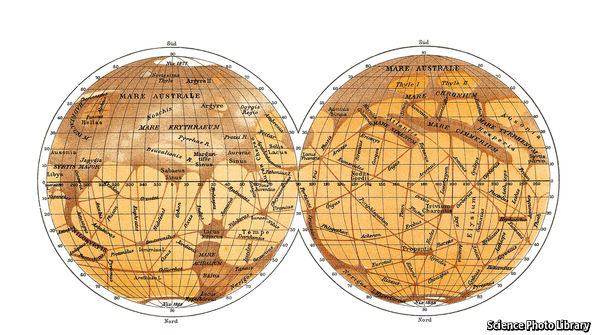 THAT space flight is as much show business as science was confirmed on the evening of October 19th, when members of the ExoMars team put on the bravest of faces for a broadcast from their mission control in Darmstadt, Ge...
How Much Does it Cost to Blow Up a Planet?
Physics Buzz - 19 Oct 2016 22:27
A curious reader wrote in today with an odd and ominous inquiry--how much would it cost to power the laser of the Death Star? We're by no means the first ones to turn an analytical eye to everyone's favorite space opera,...
Patients with insomnia have altered activity in specific brain regions
Science Daily - 19 Oct 2016 22:25
Specific brain regions, including those involved in awareness of self and tendency to ruminate, show altered activity in patients with insomnia when compared to good sleepers, according to a new study.
Neu5Gc in red meat and organs may pose a significant health hazard
Science Daily - 19 Oct 2016 22:02
A non-human sialic acid sugar molecule common in red meat that increases the risk of tumor formation in humans is also prevalent in pig organs, with concentrations increasing as the organs are cooked, a study has found.
Scientists find new genetic roots of schizophrenia
Science Daily - 19 Oct 2016 22:00 Using a recently developed technology for analyzing DNA, scientists have found dozens of genes and two major biological pathways that are likely involved in the development of the disorder but had not been uncovered in p...
First glimpse of end-of chromosome repair in real time
Science Daily - 19 Oct 2016 21:59 Maintaining the ends of chromosomes, called telomeres, allows cells to continuously divide and achieve immortality. In a new study, researchers have developed a first-of-its- kind system to observe repair to broken DNA i...
Metabolism: What is it and can it be controlled?
Science Daily - 19 Oct 2016 21:48
"I have a fast metabolism; I can eat and eat and stay skinny." Most of us have heard someone say this. But what is metabolism, and can we make ours run a bit faster? A new article helps break down what you should know ab...
European Spacecraft May Be Lost on Mars
Scientific American - 19 Oct 2016 21:00 The Schiaparelli lander’s failure to phone home has scientists fearing the worst --
Why San Francisco's next quake could be much bigger than feared
New Scientist - 19 Oct 2016 20:00
Two major fault lines in the San Francisco Bay Area are linked, and could rupture together releasing five times more energy than one of them alone
Is pain catching? First clues that it might spread to others
New Scientist - 19 Oct 2016 20:00
Scents and odours seem to be implicated in the first experiments that seem to show mice can sensitise other mice to pain
Uranus might have two dark moons we've never seen before
New Scientist - 19 Oct 2016 20:00
Newly detected wavy patterns in two of the planet's rings suggest they are being warped by two small, unseen satellites
It's fine to put a price on life, as long as it's fair
New Scientist - 19 Oct 2016 20:00
Your life might feel pricelsss to you and your loved ones, but society needs to know its value
Islands to lose fresh water as rising seas sink them from within
New Scientist - 19 Oct 2016 20:00
As sea levels rise, islands can lose ground not only on their coasts, but also inland as lakes spring up - and cause drinking water to evaporate
Is it right to kill millions of animals if it protects others?
New Scientist - 19 Oct 2016 20:00
Culls are routinely carried out around the world in the name of upholding biodiversity and animal welfare. Are they ethical and do they work, asks Alice Klein
First birds made honking sounds more than 66 million years ago
New Scientist - 19 Oct 2016 20:00
A new fossil discovery has shown that birds developed the unique vocal organ that enables them to sing more than 66 million years ago when dinosaurs were around
California is covering mountains with sensors to fight drought
New Scientist - 19 Oct 2016 20:00
A project is kicking off in the Sierra Nevada mountains to monitor moisture levels to help control the state's water supplies and hydro power
Tiny gold particles could be key to developing a treatment for pancreatic cancer
Science Daily - 19 Oct 2016 19:27
A diagnosis of pancreatic cancer is often a death sentence because chemotherapy and radiation have little impact on the disease. In the U.S. this year, some 53,000 new cases will be diagnosed, and 42,000 patients will di...
Neurodevelopmental model of Zika may provide rapid answers
Science Daily - 19 Oct 2016 19:24
A newly study demonstrates fetal death and brain damage in early chick embryos similar to microcephaly--a rare birth defect linked to the Zika virus.
Some of our Stone Age tools may just be crafty monkey throwaways
New Scientist - 19 Oct 2016 19:00
Capuchins make stone flakes that could be mistaken for hominin tools, but they do so by accident in search of mineral dust they lick, perhaps as a medication
Mystery cosmic objects light up in X-ray then go dim in an hour
New Scientist - 19 Oct 2016 19:00
Digging through old observations of galaxies, astronomers have discovered X-ray flares from objects they can't yet identify
 Global
 Great Britain
 Indian
 South Africa